Reliable monitoring of protective fuse status
As part of this project, we developed a fuse failure monitoring system that enables continuous supervision of the current installation status. The solution was designed with resilience to repeated events, temporary communication outages, and clear data presentation in a web-based user interface in mind.
The system collects data from measurement devices, analyzes their status, and presents the latest known status in the frontend application.
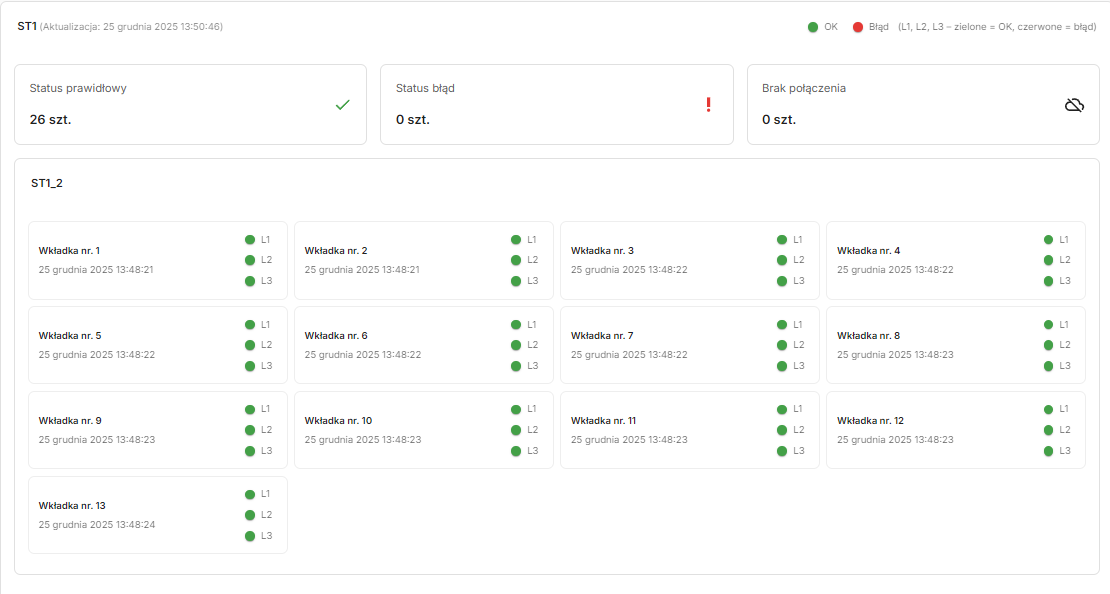
Source: internal implementation
Key project assumptions
- Monitoring of protective fuse failures
- Presentation of the current and last known state in the web interface
- Resistance to repeated messages (no event duplication)
- Controlled handling of communication loss
- Email notifications sent only after consecutive failed communication attempts
- Container-based architecture
Solution architecture
The system was divided into clear and well-defined components:
- Python backend responsible for:
- data acquisition,
- state change analysis,
- duplicate event filtering,
- notification logic management.
- Next.js frontend, providing:
- display of the current fuse status,
- recent events overview,
- a clear and user-friendly status visualization.
- Docker as the runtime layer, ensuring environment consistency and easy deployment.
Resilience to duplicates and communication loss
The system was designed to:
- prevent multiple alarms for the same unchanged state,
- store the last successfully received status,
- detect communication loss and count consecutive failed connection attempts.
Only after a predefined threshold of failed attempts is reached does the system send an email notification, significantly reducing false alarms and notification noise.
Clear visualization with Next.js
The user interface was built using Next.js, ensuring:
- fast view loading,
- real-time or near real-time data updates,
- intuitive and clear presentation of installation status.
The solution can be easily extended with user roles, event history, and integration with other systems.
Technologies used
- Python – backend, event logic, and notification handling
- Next.js – web frontend for data presentation
- Docker – containerization and deployment
- Email notification system – controlled alerting
The system provides stable and reliable monitoring of protective devices, minimizes false alarms, and enables rapid response to real incidents.
If you are interested in implementing a similar solution, feel free to contact us.